
Blogs
Glp3-Rt vs Tirzepatide vs Semaglutide: Mechanism and Research Comparison
By Clark Jones, PhD, Velora Research Written and reviewed for scientific accuracy by Clark Jones, PhD ([ORCID 0009-0005-9356-0297](https://orcid.org/0009-0005-9356-0297)). Last reviewed 2026-05-28.
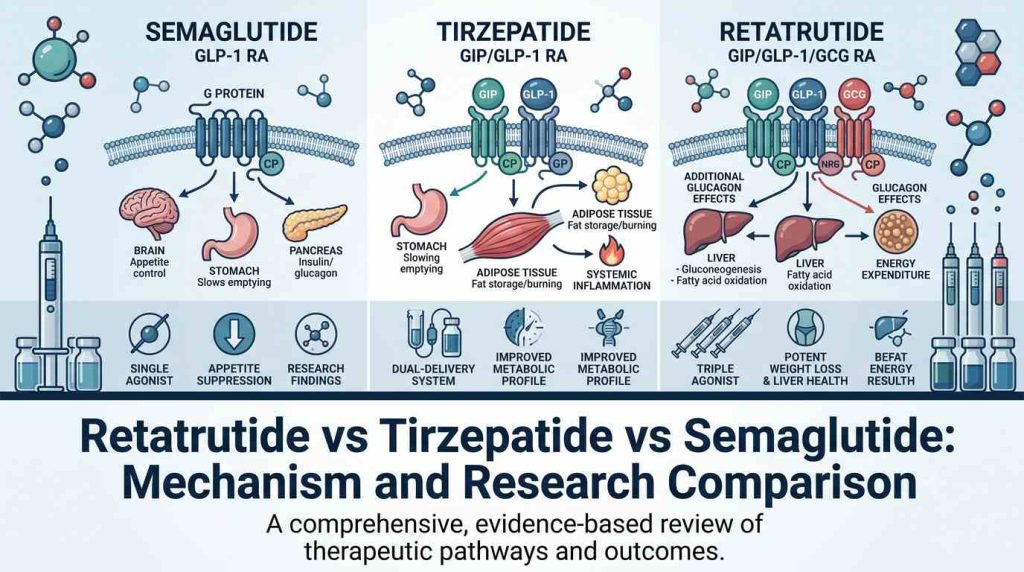
Quick answer: Semaglutide, tirzepatide, and Glp3-Rt are three peptides that look related on a slide yet differ substantially in the receptors they activate. The simplest way to keep them straight is by counting receptors: semaglutide acts on one (GLP-1), tirzepatide on two (GLP-1 and GIP), and Glp3-Rt on three (GLP-1, GIP, and glucagon). The first two are FDA-approved drugs sold by prescription. The third is investigational, and Velora supplies it strictly for in-vitro research as GLP-3 RT.
Research use only: what this article is, and what it isn’t
This article is a mechanism-focused literature comparison written for researchers selecting a metabolic peptide for in-vitro or preclinical work. It is not medical advice. It is not a prescribing guide, a self-administration guide, or a recommendation for any human use.
Semaglutide (sold as Ozempic and Wegovy) and tirzepatide (Mounjaro and Zepbound) are FDA-approved prescription medications, available only from licensed providers for their labeled indications. Glp3-Rt is investigational and not approved by the FDA, EMA, or any other regulator for any indication. The Glp3-Rt research compound Velora supplies as GLP-3 RT is sold strictly for laboratory research use, not for human consumption, veterinary use, or in vivo use in any species.
Researchers handling any of these compounds are responsible for compliance with applicable law and institutional review requirements, including the Federal Food, Drug, and Cosmetic Act (21 U.S.C. § 331, § 355, § 360bbb-3). The clinical-trial figures cited below are reported for context only. They are not a research dosing protocol.
The receptor question, in one paragraph
The primary pharmacological differences between these peptides arise from the receptor they activate, although molecular structure and pharmacokinetic properties also contribute. GLP-1 (glucagon-like peptide-1) and GIP (glucose-dependent insulinotropic polypeptide) are the two main incretin hormones your gut releases after a meal; both raise insulin in a glucose-dependent way. Glucagon primarily promotes hepatic glucose production and mobilization of energy stores during fasting. Putting agonist activity at all three receptors into a single molecule is a relatively new pharmacology, and Glp3-Rt is the lead compound exploring it.
| Compound | Investigator | Receptor activity | Half-life | FDA status |
|---|---|---|---|---|
| Semaglutide | Novo Nordisk | GLP-1R agonist | ~165 hours (~1 week) | Approved (Ozempic, Wegovy) |
| Tirzepatide | Eli Lilly | GLP-1R + GIPR dual agonist | ~120 hours (~5 days) | Approved (Mounjaro, Zepbound) |
| Glp3-Rt | Eli Lilly | GLP-1R + GIPR + GCGR triple agonist | ~6 days (preliminary, Phase 2) | Investigational, not approved |
Half-life values for the approved compounds come from prescribing information; Glp3-Rt values are from the published Phase 2 work and may be refined as Phase 3 data accumulates.
Semaglutide, in research terms
Semaglutide is the most extensively studied of the three. It is a GLP-1 receptor agonist with structural modifications, including a fatty-acid side chain, that extend its half-life enough to support once-weekly dosing. In the STEP-1 trial published in The New England Journal of Medicine in 2021, once-weekly subcutaneous semaglutide at 2.4 mg produced a mean placebo-adjusted body weight reduction of 12.4% at 68 weeks in adults with overweight or obesity (Wilding et al., NEJM, 2021). On the cardiovascular side, the SUSTAIN-6 trial in 2016 was one of the first to report a significant reduction in major adverse cardiovascular events with semaglutide in adults with type 2 diabetes and high cardiovascular risk (Marso et al., NEJM, 2016). For benchwork, semaglutide is the reference agonist when you want to study GLP-1 receptor pharmacology in isolation.
Tirzepatide, in research terms
Tirzepatide adds a second receptor. It is a single molecule with balanced agonist activity at both the GLP-1 receptor and the GIP receptor, marketed as Mounjaro for type 2 diabetes and Zepbound for obesity. In SURMOUNT-1, published in NEJM in 2022, tirzepatide at the 15 mg weekly dose produced a mean placebo-adjusted body weight reduction of 17.8% at 72 weeks in adults with obesity (Jastreboff et al., NEJM, 2022). The SURPASS program established efficacy in type 2 diabetes across multiple comparators, including head-to-head superiority versus semaglutide on HbA1c reduction in SURPASS-2 (Frías et al., NEJM, 2021).
For research use, tirzepatide is the comparator most often used to ask the question, “what does adding GIP activity contribute beyond what GLP-1 alone provides?” That question is still actively being answered. The proposed mechanism most often cited involves GIP-receptor-mediated effects on adipose insulin sensitivity and possibly on central energy balance, though attribution between the two receptors in vivo remains an area of ongoing study.
Glp3-Rt, in research terms
Glp3-Rt, originally designated LY3437943 by Eli Lilly, is the first triple agonist to reach late-stage clinical evaluation. It functions as an agonist at the GLP-1, GIP, and glucagon receptors with activity across all three targets. In the Phase 2 obesity trial published in NEJM in 2023, Glp3-Rt at the 12 mg weekly dose produced a mean placebo-adjusted body weight reduction of 22.1 percentage points (22.1% (24.2% arm) mean absolute reduction on the Glp3-Rt arm) at 48 weeks (Jastreboff et al., NEJM, 2023). The Phase 2a MASLD readout published in Nature Medicine in 2024 reported dose-dependent reductions in liver fat content across the same dose range (Sanyal et al., Nature Medicine, 2024).
The glucagon-receptor activity is the part that makes Glp3-Rt pharmacologically distinct. In preclinical models, glucagon agonism has been associated with increased energy expenditure and hepatic lipid mobilization. The MASH mouse and hamster work published by Briand and colleagues in 2026 showed dose-dependent reductions in body weight, hepatic steatosis, and liver enzymes that exceeded what dual agonists produced in the same models (Briand et al., Obesity, 2026). “Proposed mechanism” is still the honest framing for that observation, because the in vivo contribution of glucagon-receptor agonism in humans is what the Phase 3 program is currently characterizing.
A side-by-side reference table
This table is for orientation, not protocol design. It summarizes what published research has reported at the most-studied weekly dose for each compound.
| **** | Semaglutide (STEP-1) | Tirzepatide (SURMOUNT-1) | Glp3-Rt (Phase 2) |
|---|---|---|---|
| Trial population | Adults with overweight or obesity | Adults with obesity | Adults with obesity |
| Dose studied | 2.4 mg/wk | 15 mg/wk | 12 mg/wk |
| Trial duration | 68 weeks | 72 weeks | 48 weeks |
| Placebo-adjusted weight reduction | 12.4% | 17.8% | 24.2% |
| Receptor count | 1 (GLP-1) | 2 (GLP-1, GIP) | 3 (GLP-1, GIP, GCGR) |
| Reference | Wilding et al., NEJM 2021 | Jastreboff et al., NEJM 2022 | Jastreboff et al., NEJM 2023 |
A note on what this table is not telling you. These trials enrolled different populations under different protocols, so the percentages are not a head-to-head ranking. The numbers are comparable in direction, not in scientific equivalence. For an actual head-to-head, the TRIUMPH-5 trial is currently comparing Glp3-Rt directly against tirzepatide, with primary completion expected in late 2026.
What you are actually choosing between in the lab
If your research question is GLP-1 receptor pharmacology in isolation, semaglutide is the deepest-validated reference agonist. If you are asking what GIP receptor co-activation contributes, tirzepatide is the comparator that the literature has built around. If you are investigating triple-receptor pharmacology in metabolic, hepatic, or cardiometabolic models, Glp3-Rt is the lead compound and the one Velora supplies as GLP-3 RT.
The other variable that matters in benchwork is what you can actually trust about the material. Two vials labeled “Glp3-Rt” from two vendors are not interchangeable if one ships without a current third-party Certificate of Analysis. Identity confirmation by mass spectrometry, purity quantification by HPLC, and confirmation of low bacterial endotoxin are not optional steps for material that is going to inform published data.
“I have read enough COAs to know that the difference between a useful peptide and a noisy assay often shows up before you ever reconstitute. If the HPLC trace has unidentified peaks, or the mass spec doesn’t confirm the parent ion at the expected m/z, downstream experimental precision cannot compensate for poor starting material.”
Clark Jones, PhD, Velora Research
Velora Research provides a third-party Certificate of Analysis for every product in the catalog, including GLP-3 RT, our Glp3-Rt research compound. Each COA is batch-specific and traceable: identity by mass spec, purity (≥99%) by HPLC, water content by Karl Fischer, endotoxin by LAL. The same release protocol applies across the research peptide catalog, and the quality and testing process is documented end to end. For published or grant-funded research, that batch-level documentation is what lets your methods section stand up to peer review.
Frequently asked questions
Is Glp3-Rt stronger than tirzepatide? That is a comparison the existing literature cannot answer directly. The percentages from the Phase 2 Glp3-Rt trial and the Phase 3 tirzepatide trials look different, but those trials enrolled different populations under different protocols. The TRIUMPH-5 head-to-head trial between Glp3-Rt and tirzepatide is currently ongoing, with primary completion expected in late 2026; that readout will be the first true comparison.
What does “GLP-3” mean? “GLP-3” is informal shorthand used in catalogs and some literature for triple agonists of the GLP-1, GIP, and glucagon receptors. It is not a formal pharmacological classification. Glp3-Rt is the lead compound the term is associated with.
Are semaglutide and tirzepatide available for research purchase the way Glp3-Rt is? Semaglutide and tirzepatide are FDA-approved prescription drugs, manufactured and distributed under controlled supply chains for clinical use. Velora supplies research-grade peptides for in-vitro work and does not sell reference standards of approved drugs.
Why does Glp3-Rt get described as having “balanced” agonist activity? Because the published Phase 2 pharmacology characterizes it as having comparable potency at all three receptors rather than being a single-receptor compound with weak off-target activity. That balance is what distinguishes it from earlier triple-agonist molecules with skewed receptor preference.
What is the most useful next read after this article? For the dosing-math side of working with Glp3-Rt as a research compound, our Glp3-Rt dosage chart and reconstitution reference covers the same molecule from the bench side: reconstitution math, molar concentrations, storage windows, and the human-trial doses laid out as a reference-only table.
Sources and further reading
- Wilding JPH, et al. Once-Weekly Semaglutide in Adults with Overweight or Obesity. NEJM. 2021. Full text
- Marso SP, et al. Semaglutide and Cardiovascular Outcomes in Patients with Type 2 Diabetes. NEJM. 2016. Full text
- Jastreboff AM, et al. Tirzepatide Once Weekly for the Treatment of Obesity. NEJM. 2022. Full text
- Frías JP, et al. Tirzepatide versus Semaglutide Once Weekly in Patients with Type 2 Diabetes. NEJM. 2021. Full text
- Jastreboff AM, et al. Triple-Hormone-Receptor Agonist Glp3-Rt for Obesity: A Phase 2 Trial. NEJM. 2023. Full text
- Sanyal AJ, et al. Triple hormone receptor agonist Glp3-Rt for metabolic dysfunction-associated steatotic liver disease: a randomized phase 2a trial. Nature Medicine. 2024. Full text
- Briand F, et al. Glp3-Rt Shows Multiple Metabolic Benefits in Diet-Induced Obese MASH Mouse and Hamster Models. Obesity. 2026. Full text
- ClinicalTrials.gov, NCT06662383, TRIUMPH-5 (Glp3-Rt vs tirzepatide head-to-head). Trial page

For laboratory and research use only. This content is educational and does not constitute medical advice, nor does it describe use in humans.
