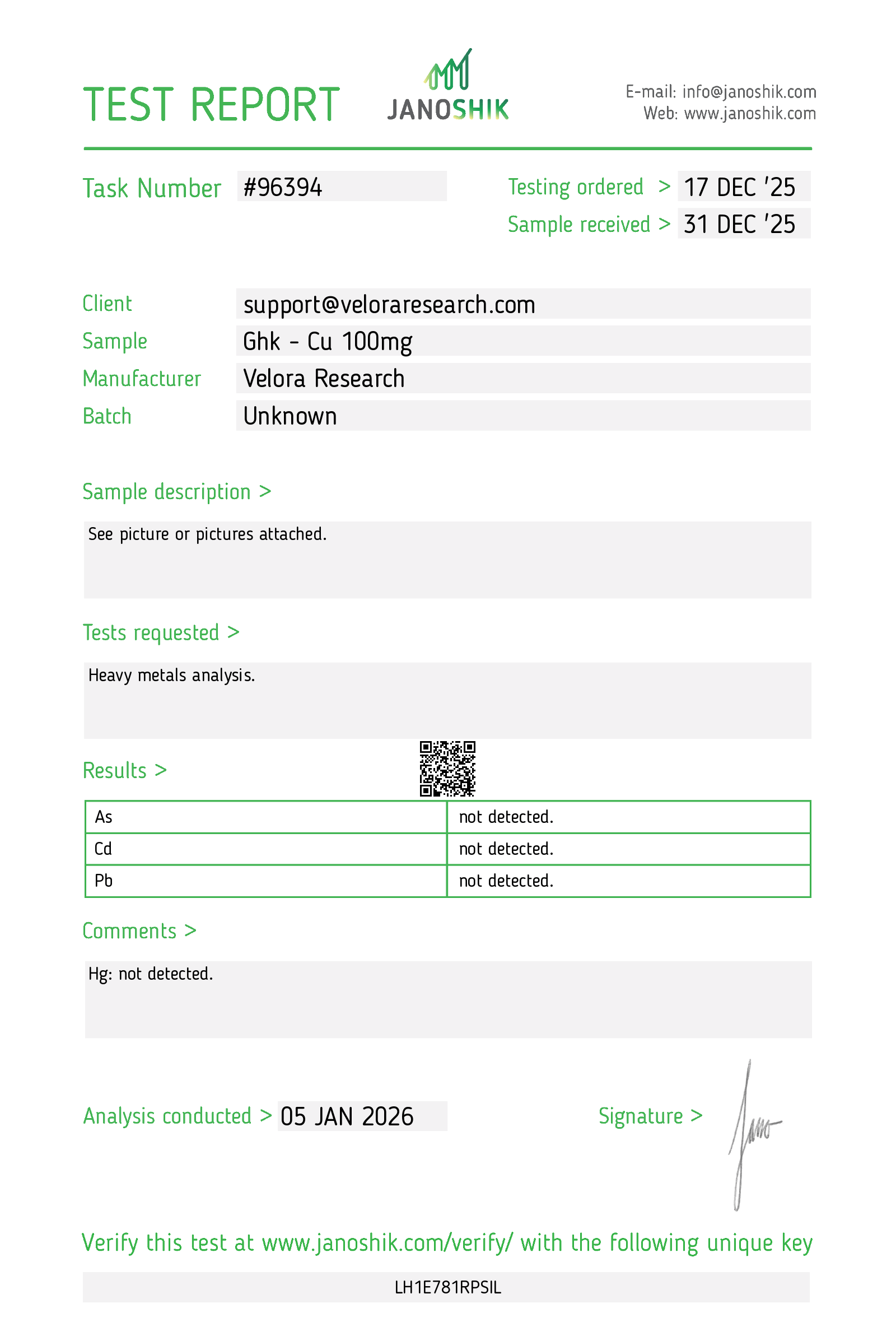


Description
About GHK-Cu peptide (research compound)
GHK-Cu is the copper-bound form of the tripeptide glycyl-L-histidyl-L-lysine — a small, naturally occurring sequence first isolated from human plasma by Loren Pickart in 1973. The copper ion binds at the histidine residue to form a stable Cu(II) chelate (sometimes written GHK-Cu²⁺ or [Cu²⁺-GHK]). It is one of the most extensively studied copper peptides in preclinical literature, with research interest spanning tissue-remodeling models, collagen and elastin synthesis assays, antioxidant chemistry, and follicular biology.
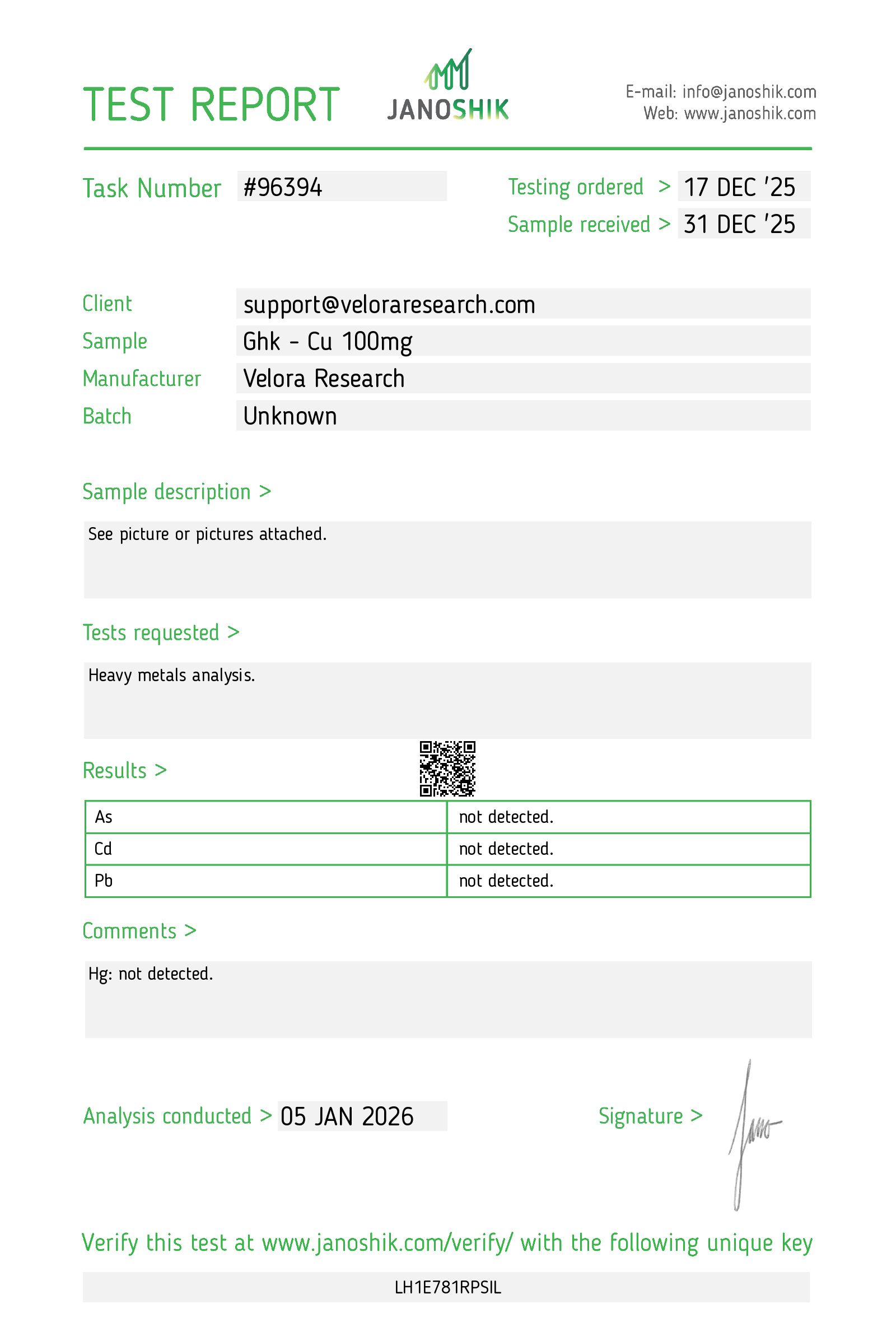
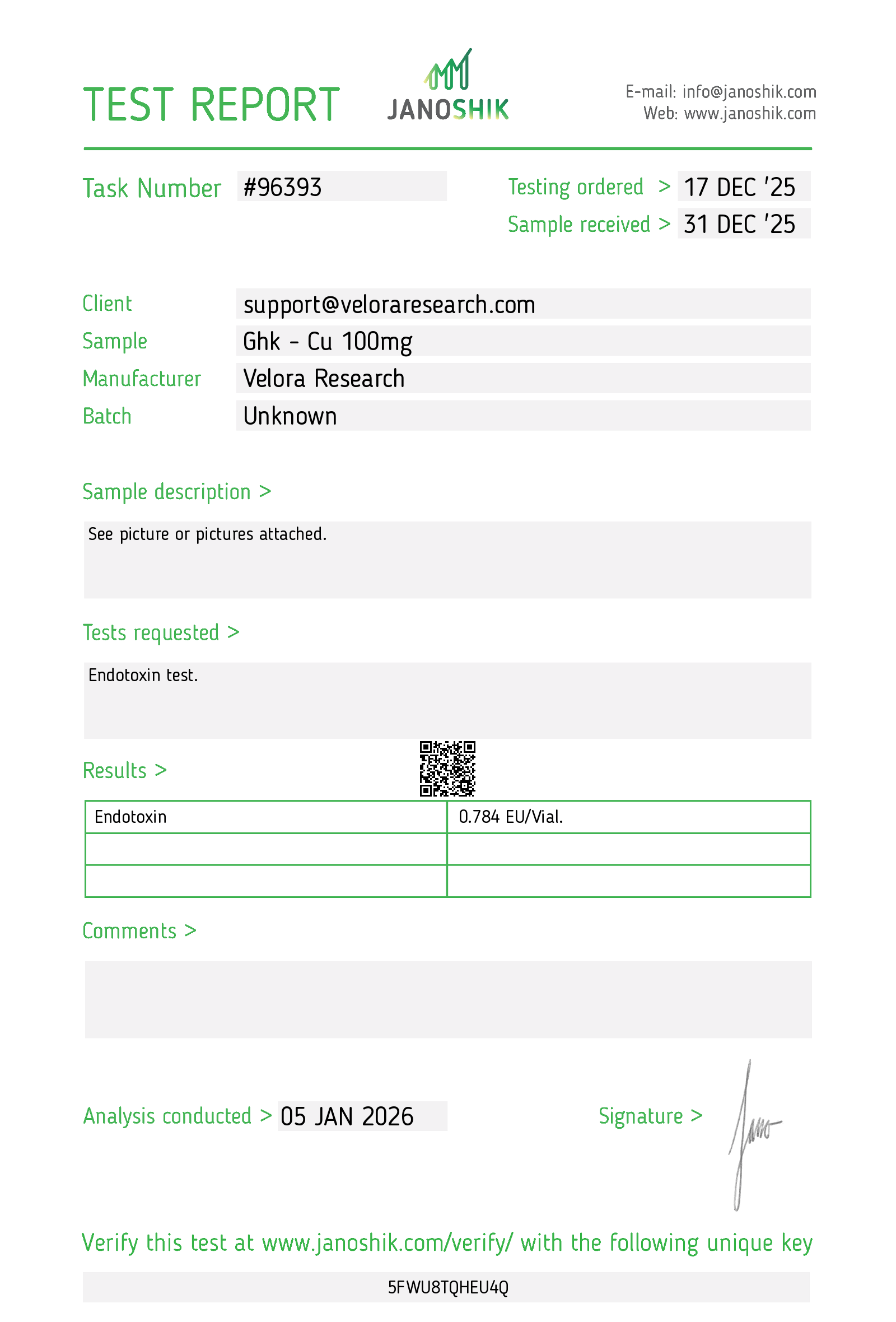
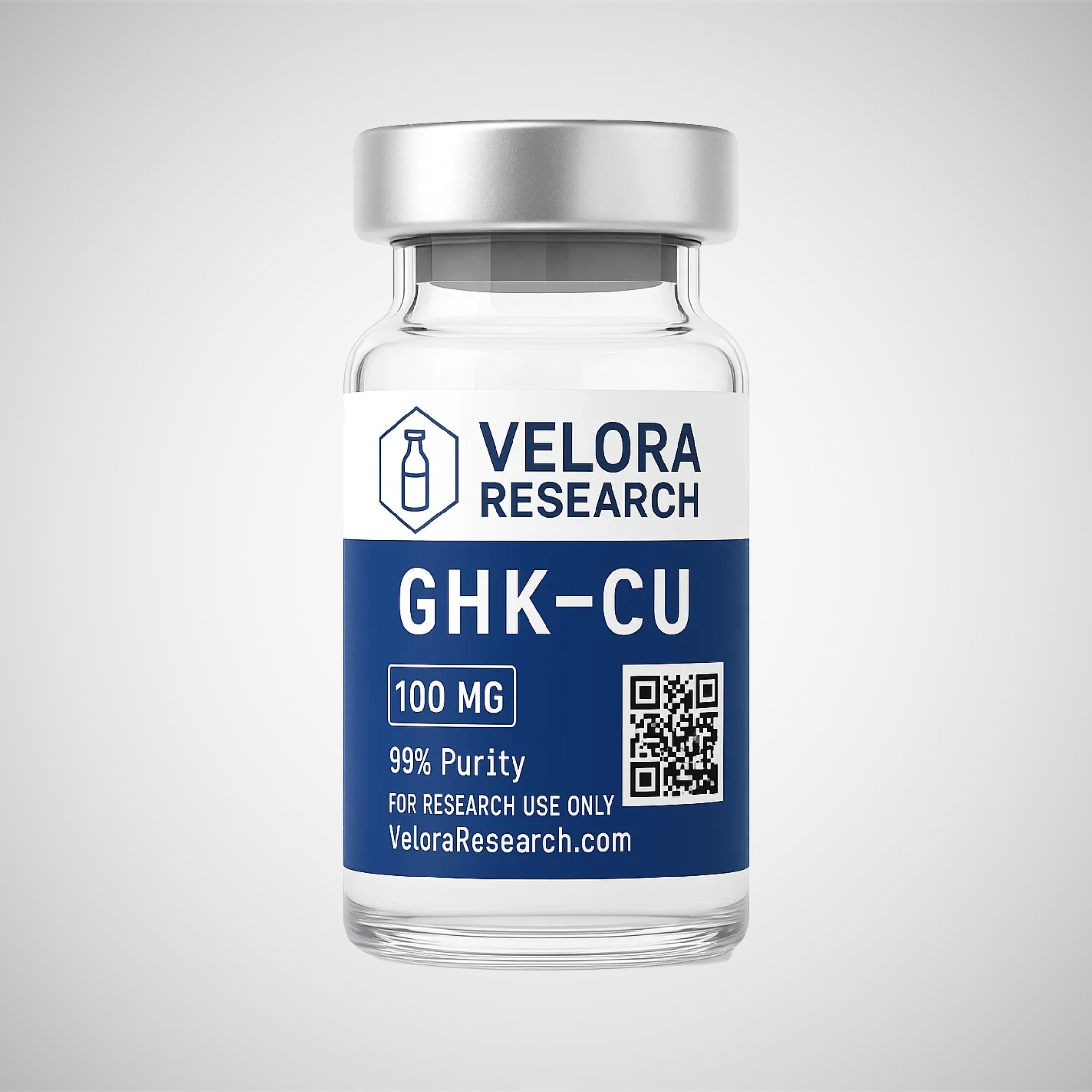
Velora Research supplies the GHK-Cu peptide as a 100mg lyophilized vial for in vitro and preclinical investigation by qualified laboratories and research professionals. Every batch is independently verified by a third-party analytical laboratory using high-performance liquid chromatography (HPLC) for purity and mass spectrometry for identity confirmation. The batch-specific Certificate of Analysis is published on our COAs page and linked from this product page.
What is GHK-Cu peptide?
GHK-Cu is a coordination complex between the tripeptide glycyl-L-histidyl-L-lysine (“GHK”) and a copper(II) ion. The peptide portion provides the binding pocket — copper coordinates with the histidine nitrogen, an amino group, and a peptide-bond nitrogen — producing a stable, water-soluble research compound. GHK occurs naturally in human plasma at concentrations that decline with age (published studies report ~200 ng/mL in adults around age 20, dropping to ~80 ng/mL by age 60), which has driven sustained research interest in the GHK-Cu peptide as a model compound for age-related cellular biology.
Mechanism — what published research describes
Across cell-culture and preclinical studies, GHK-Cu peptide has been characterized as a multi-pathway research compound. Published mechanisms of interest include:
- Copper-transport chemistry. The GHK-Cu complex serves as a copper carrier; published research describes copper handoff to ceruloplasmin, superoxide dismutase, and lysyl oxidase in cell models.
- Antioxidant activity. Documented in in-vitro assays as a modulator of reactive-oxygen-species pathways and a chelator of free copper, which is itself pro-oxidant.
- Extracellular-matrix research. Cell-culture studies describe GHK-Cu interactions with fibroblast-derived collagen and glycosaminoglycan production pathways.
- Gene-expression modulation. Published transcriptomic work has profiled GHK-Cu effects on gene clusters relevant to cell proliferation, DNA repair, and inflammation pathways in cultured fibroblasts.
All mechanisms above are drawn from peer-reviewed preclinical and in-vitro research. Velora Research supplies the GHK-Cu peptide solely for further investigation of these and related research questions in laboratory settings.
Key specifications
| Attribute | Specification |
| Research name | GHK-Cu peptide (copper peptide GHK-Cu) |
| Chemical name | Glycyl-L-histidyl-L-lysine-copper(II) complex |
| Sequence | Gly-His-Lys (tripeptide) + Cu²⁺ |
| Available size | 100mg |
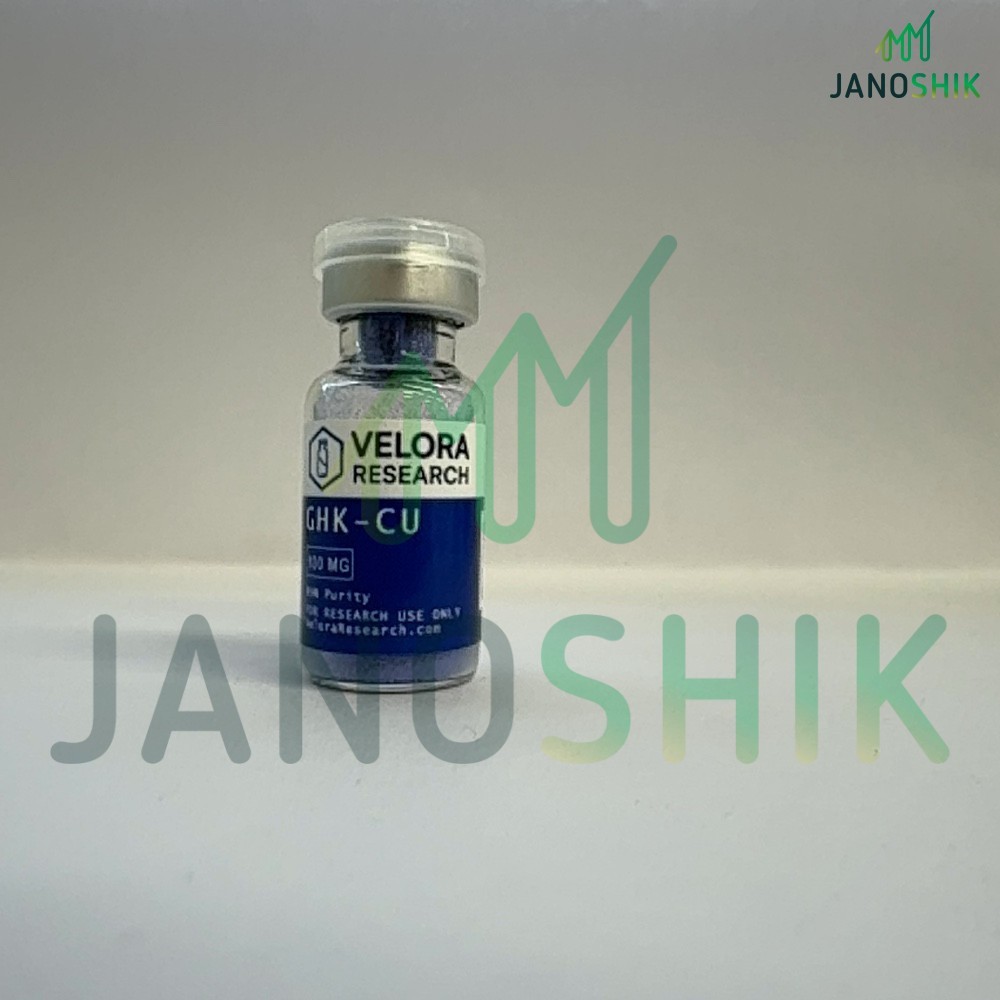
| Form | Lyophilized blue-tinted powder (color due to copper coordination) |
| Purity | ≥99% (HPLC verified) |
| Molecular formula | C14H24N6O4Cu |
| Molecular weight | ~340.87 g/mol |
| CAS number | 89030-95-5 |
| Storage (lyophilized) | -20°C, sealed, dry, dark (copper-bound peptides are light-sensitive) |
| Storage (reconstituted) | 2-8°C, protected from light, single-use aliquots recommended |
| Verification | Independent third-party HPLC + mass spectrometry per batch |
| COA access | Batch-specific COA at verify.janoshik.com (linked from this page) |
GHK-Cu peptide pricing
Velora Research lists the GHK-Cu peptide at a single 100mg tier, sized so a single vial typically covers an entire pilot study or a multi-arm cell-culture experiment without re-ordering:
| Vial size | Price (USD) | Best for |
| 100mg | $60.00 (sale pricing periodically available) | Pilot studies, cell-culture assays, multi-arm preclinical work, antioxidant chemistry research |
Free US shipping applies on orders over $200; most orders ship within 1–2 business days. Because GHK-Cu peptide is light-sensitive, every shipment is packaged in opaque protective material to preserve copper coordination during transit.
GHK-Cu benefits as characterized in published research
“GHK-Cu benefits” is a common search query among researchers screening compounds for inclusion in studies. The areas of published research interest below summarize how peer-reviewed in-vitro and preclinical literature has characterized the compound. All language is research-frame — none of these are therapeutic claims, and none describe approved human-use indications.
- Tissue-remodeling research. Documented effects in cell-culture models on fibroblast proliferation rate, collagen Type I synthesis, and matrix metalloproteinase expression.
- Antioxidant chemistry. Characterized as a Cu(II) chelator and SOD-pathway modulator in in-vitro assays.
- Extracellular-matrix synthesis. Published research describes effects on glycosaminoglycan and decorin production in cultured fibroblasts.
- Follicular research models. Cell-culture and ex-vivo follicular assays have profiled GHK-Cu peptide interactions with dermal papilla cells and follicular growth-phase signaling.
- Gene-expression profiling. Microarray work has characterized GHK-Cu effects on clusters of genes associated with cell repair, inflammation, and oxidative-stress response.
These represent published areas of research interest only. Velora Research makes no claim that GHK-Cu peptide produces any specific outcome in humans, animals, or cosmetic applications. The compound is supplied for in vitro and preclinical research investigation only.
Why qualified researchers buy GHK-Cu peptide from Velora Research
Five things separate Velora Research from generic peptide suppliers:
- Batch-level third-party COA. Each lot is verified by an independent analytical lab using HPLC and mass spectrometry; the COA is downloadable from the product page and tied to the batch number printed on the vial. This matters more for copper peptides than for unbound peptides because copper coordination integrity is part of the identity verification.
- ≥99% HPLC-verified purity. Identity, purity, and molecular integrity confirmed before any batch is released for sale.
- Light-protected packaging. GHK-Cu peptide is sensitive to light exposure; Velora’s shipments are sealed in opaque material to preserve copper coordination during transit.
- US-based 2-day shipping. Free over $200; orders processed within 1–2 business days.
- Compliance-first sales policy. Sales restricted to qualified laboratories, institutions, and research professionals. Research-use-only terms acknowledged at checkout.
Reconstitution & storage guidance (research use)
Velora’s GHK-Cu peptide ships as a lyophilized powder with a faint blue tint characteristic of copper coordination. For in vitro studies, researchers typically reconstitute with bacteriostatic water (0.9% benzyl alcohol) or, for cell-culture protocols, with sterile water or PBS at concentrations matched to the assay. A common pilot ratio for a 100mg vial is 5 mL of diluent, yielding a 20 mg/mL stock solution — adjust per your study design.
- Pre-reconstitution: store sealed at -20°C in a dry, dark environment. Avoid freeze-thaw cycles and keep the vial protected from ambient light, which can affect copper coordination.
- Post-reconstitution: refrigerate at 2-8°C protected from light. Use within the stability window established by the research protocol. Single-use aliquots reduce light and temperature exposure.
- Topical research preparations: published topical-research protocols frequently use carrier vehicles other than BAC water — consult the peer-reviewed literature for vehicle compatibility and pH ranges.
- Handling: reconstitute and aliquot under sterile lab conditions with appropriate PPE.
Velora Research supplies bacteriostatic water as a separate product. Please refer to the peer-reviewed literature for protocol-specific reconstitution and handling parameters.
GHK vs. GHK-Cu — research-context distinction
Researchers evaluating GHK-Cu often weigh the copper-bound form against the unbound GHK tripeptide. Summary of how the two differ at the chemistry level:
| Attribute | GHK (unbound) | GHK-Cu (copper peptide) |
| Composition | Glycyl-L-histidyl-L-lysine tripeptide alone | GHK + Cu²⁺ coordination complex |
| Appearance (lyophilized) | White powder | Blue-tinted powder (copper signature) |
| Molecular weight | ~340 g/mol (peptide); ~340 g/mol total | ~340 g/mol (entire complex) |
| Functional pattern in published research | Studied as the peptide carrier; binds copper from solution | Studied as the pre-formed bioactive complex |
| Stability | More susceptible to oxidative degradation | Copper coordination contributes to peptide stability in published assays |
Both forms appear in preclinical literature. Velora supplies the copper-bound GHK-Cu peptide for studies that depend on the pre-coordinated Cu(II) complex.